
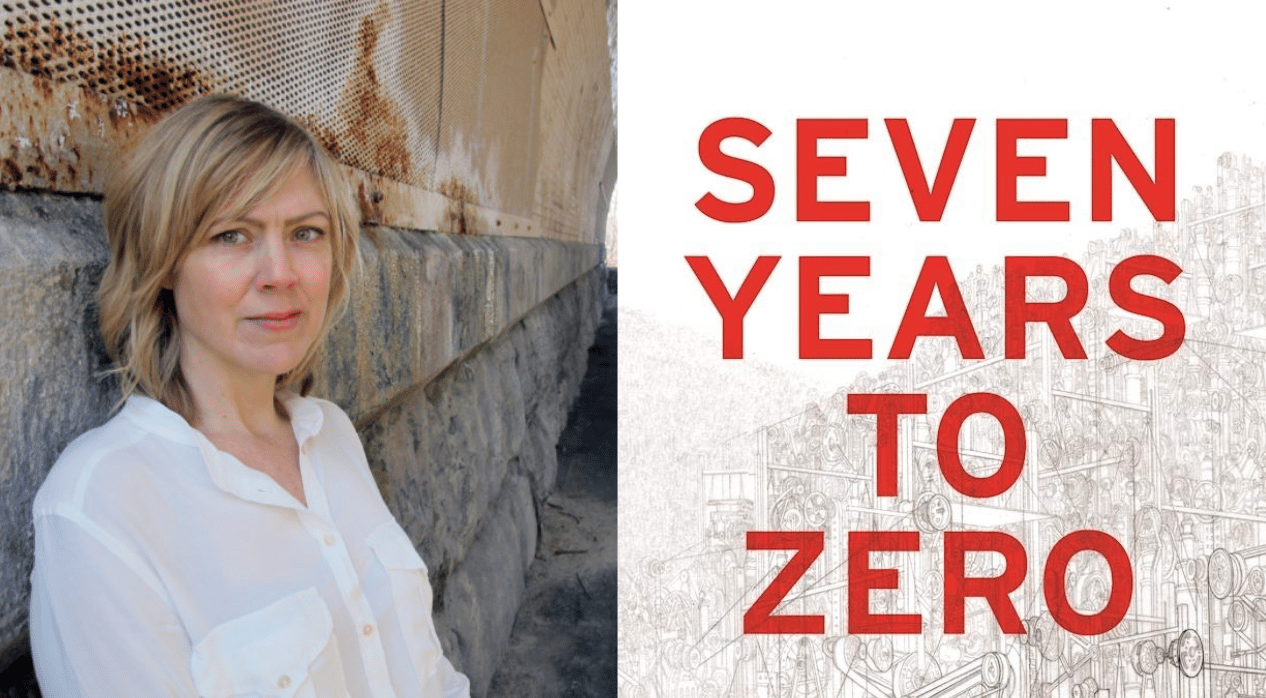
Creative Nonfiction by Amy Benson
The following excerpt is from Seven Years to Zero: Sketches of Art in the Anthropocene, out May 2, 2017 from Dzanc Books.
We come from towns where the water runs thick with nitrogen in the spring. Or towns where front lawns are covered in white stones and defensive plants. Towns where we know the kid they’re collecting for at the gas station. Towns in which the most crowded buildings are nursing homes. Towns where a girl disappears and you will find no one who saw it coming.
We come from suburbs with churches the size of malls. Suburbs where they fix Brazilian cocktails and cleaning fluid drugs. Suburbs where the houses are squat bunkers and the trees cool and tall. And suburbs where the doors and walls are hollow.
We come from cities that have worked their rivers brown. Cities with the scars of streetcars. Cities that buy their movie reviews from the newspapers of other cities. Cities that like dogs and scrapped-tire decking and wild-caught salmon.
We come from places where people get close enough to touch only across cashier counters. Where you might believe you are the first to see something, own something, bury something.
We thought we didn’t have accents or style. We thought we’d been uncreased. We thought polls were never talking about us. And we’ve come to the tallest, densest place, a city that will never need a marketing campaign. But we come with our eyes normal-sized and open in our heads.
In fact, we didn’t always want to come, and we worried, some of us, about what might happen to our brains: how could we think when we knew that in every direction, for miles, millions of people were also thinking. The air looked like a nest of wires.
We visited a city beach once, before we moved, but we could not get into the ocean, though it was ninety degrees, though we love the water. A few feet was the farthest we could have gotten from the next pair of legs. Everyone the same water, the same sand. How could we imagine our thoughts were new?
These thoughts, we suspect, will come less and less frequently. We are a demographic, and there will only be more of us — a map littered with pins, all threads leading here. At the threshold of the hive, we almost never feel like we’re in a prison of lungs and legs and greasy palms. We’re happy with an open park bench.
The Octagon Room
It looked like a temporary shelter preparing for deluge. That is what we saw when we walked into the gallery — a little structure built from unadorned plywood, buttressed by two-by-fours, and shored up with sandbags. There was the suggestion that, despite the reinforcements, one jostled beam and the whole thing might fall open like a blown flower. When we stepped inside the room, however, we were in the implacable nineteenth century, stranger to compressed wood and polypropylene bags.
It was, in fact, an octagon room, fad of the mid-to-late 1800s for people who liked a wall so much they wanted a new one every time they shifted. In the middle of this octagon room was an octagon settee, one wedge of dusky rose upholstery facing each wall. Sit, it said, and study. And there was much to study. Part genteel office, part Wunderkammer, part natural history museum, the room was a fistful of lists. Maps, antique desks, drawings of fish and birds, excavation tools, specimen jars, card catalogue bureaus. Taxidermied animals; shards of pottery dredged from riverbeds; bookshelves with Spencer, Conrad, Machiavelli; and notes and sketches, some of which appeared to represent a nascent version of the room itself. Every item hinted at a history, a field of study, a way of framing the question, as if, 150 years ago, a net had been dragged through the northern European forests, rivers, libraries, and museums, the bounty hauled home and painstakingly organized.
The imagined proprietor of the room was a gentleman scientist, natural historian, collector, archaeologist, environmentalist, humanist, and colonialist. A Victorian intellectual who wrote a book for every idea he had, easy in his anticipation of mastery.
But the artist who created him was wise about that desire to label and preserve, about the assumption that collecting equals knowing. And he had a wicked sense of humor. There was a shadow box lined with labeled keys, the handsome script on which suggested some keys might open real gates or doors or boxes, and some might open imaginary museums or even portals to other worlds. Deer heads mounted on the wall looked as if they’d been fished from the Exxon Valdez spill. A map was hung so high above the doorframe that it became entirely unable to inform or direct.
After a while, we zeroed in on a favorite: a taxidermied turtle. It was posed as if in mid-step, and piled high on its back was a conglomeration of shell, stone, sand, and human artifacts — teacup shards, buttons, fragments of antiquated children’s games. As if it had hibernated for several centuries in the mud and, at last, risen up through the layers, its shell an archaeological dig. Turtle was, breath by labored breath, hauling it all into the future.
If we could have taken the turtle home, we would have. A reminder of the weight of human history crawling across our coffee table. Our guests might focus on the turtle’s front foot poised to step and politely ignore that it was stuffed by the very same instinct for preservation that says: I’ll kill you, but I won’t let you go.
We stayed as long as we could, itching to thumb through the card catalogue and contents of the roll-top desk. We had the strong impression that the room was telling us something essential, something we needed to know before we could move on. We had come in from the street, where we were learning selective sensing — how could we notice every noise, every threat, how could we follow the news feeds scrolling 360 degrees around us, and still get where we were going? We had grown up learning how solutions became problems and order became greater chaos — how cats brought in to catch mice themselves needed catching; how spent nuclear rods piled up in the no-longer-cool cooling baths; how a war to end all wars scattered the seeds of a thousand more; how there was something in the water no matter the well. Now here were eight walls of sincere collection and its brilliant critique. We thought we might be able to absorb the Octagon Room’s modus operandi. See everything, including the limitations of our sight.
We stayed until our attention became strained, a performance, and then slipped outside and looked back. We were shocked to see, once more, the plywood, the sandbags, shocked at how, inside the room, we would have disavowed any memory of the raw and flimsy present. It was a blow but not a surprise to learn from a gallery attendant that the show would close in another week. The room would go into boxes, and then…where?
Before the week was up, we returned with a digital camera and, without considering the irony, photographed every inch of all eight walls — 180 pictures, at which we have never looked back.

Amy Benson is the author of The Sparkling-Eyed Boy (Houghton Mifflin 2004), winner of the Bakeless Prize in creative nonfiction, sponsored by Bread Loaf Writer’s Conference. Recent work has appeared in journals such as Agni, BOMB, Boston Review, Denver Quarterly, Gettysburg Review, Kenyon Review, PANK, and Triquarterly. She has taught creative writing at Columbia University and Fordham University and will join the writing faculty at Rhodes College in Memphis in the fall. She was a fellow at Bread Loaf and a resident at Ledig House International, and is the co-founder of the First Person Plural Reading Series in Harlem.
 Arcturus