
Creative Nonfiction by Sophie Fetokaki
How does a love end? — Then does it end? To tell the truth, no one — except for the others — ever knows anything about it; a kind of innocence conceals the end of this thing conceived, asserted, lived according to eternity. Whatever the loved being becomes […] I never see him disappear: the love which is over and done with passes into another world like a ship into space, lights no longer winking: the loved being once echoed loudly, now that being is entirely without resonance (the other never disappears when and how we expect). This phenomenon results from a constraint in the lover’s discourse: I myself cannot (as an enamoured subject) construct my love story to the end: I am its poet (its bard) only for the beginning; the end, like my own death, belongs to others; it is up to them to write the fiction, the external, mythic narrative.
-Roland Barthes, A Lover’s Discourse
About two and a half thousand years before Barthes wrote these words, Euripides was also thinking about love, death and things that dissolve and disappear. His play Alkestis opens with the death of its main character, a woman who has generously offered to take her husband’s place in Hades. The death itself is somewhat protracted and takes up just over a third of the play, from the opening lines to her death in line 395. Repetition and paraphrase are a frequent feature of these lines, such as those leading up to her death, which contain so many paraphrases of ‘I’m dying’ that one begins to wonder if this might have been the inspiration for Monty Python’s Dead Parrot Sketch. Shortly after she finally ‘runs down the curtain to join the choir invisible’ the chorus turns to Admetus and addresses him directly, unfurling a satin surface of moderate reasoning that is shorn again and again by his violent morphemes, by the irreducibility of his grief.
In 1988 the Mexican songwriter Tomas Mendez released the song “Paloma Negra”. The lyrics are in Spanish, a language in which just one letter separates the present indicative (as in no vuelves, you do not return) from the negative imperative (as in no vuelvas, do not return) — such that a non-fluent speaker could easily make this slip. In “Paloma Negra” the imperative form occurs in the line aunque te amo con locura ya no vuelvas. Although perfectly easy to translate, one cannot say such things in English. One cannot really say them in Spanish either, which is why there is singing. If it weren’t for singing a lot of very important things would go unsaid.
When Barthes’ lovers speak, they say:
           I repeat
                         I repeat to satiety
                                     I am the motif of a hovering music
                                                 my discourse is not dialectical
                                                             it turns like a calendar
                                                                         like an encyclopaedia of affect
                                                                                     like a synodic whirling dance
                                                                                                 etc.
Synodic is from the Greek (as are many words relating to planets, medicine, biology, etc) συνοδικός, ‘of or relating to an assembly or meeting’. But this is not what’s interesting, let’s break it a bit more.
σύν (with) + ὁδός (way, path)
A synod can be a meeting of the paths of two heavenly bodies. That minute when they pause in their whirl to stare at each other.
In the grey there are flecks of blue.
Latin et cetera is calqued from Koine Greek καί τα ἕτερα (and the other things). Here’s a piece of linguistic trivia for you: the word ‘calque’ — a direct translation of the morphemic elements of a word, or the words of a phrase — is a loanword from the French calquer, ‘to trace, to copy’; while ‘loanword’ is a calque of the German Lehnwort.
A calque retains the internal structure of the word or phrase and the concept anchored to it, but changes the sound; a loanword retains the sound but adjusts the concept. Both of these phenomena are often the result of what is amusingly termed ‘bilingual interference’.
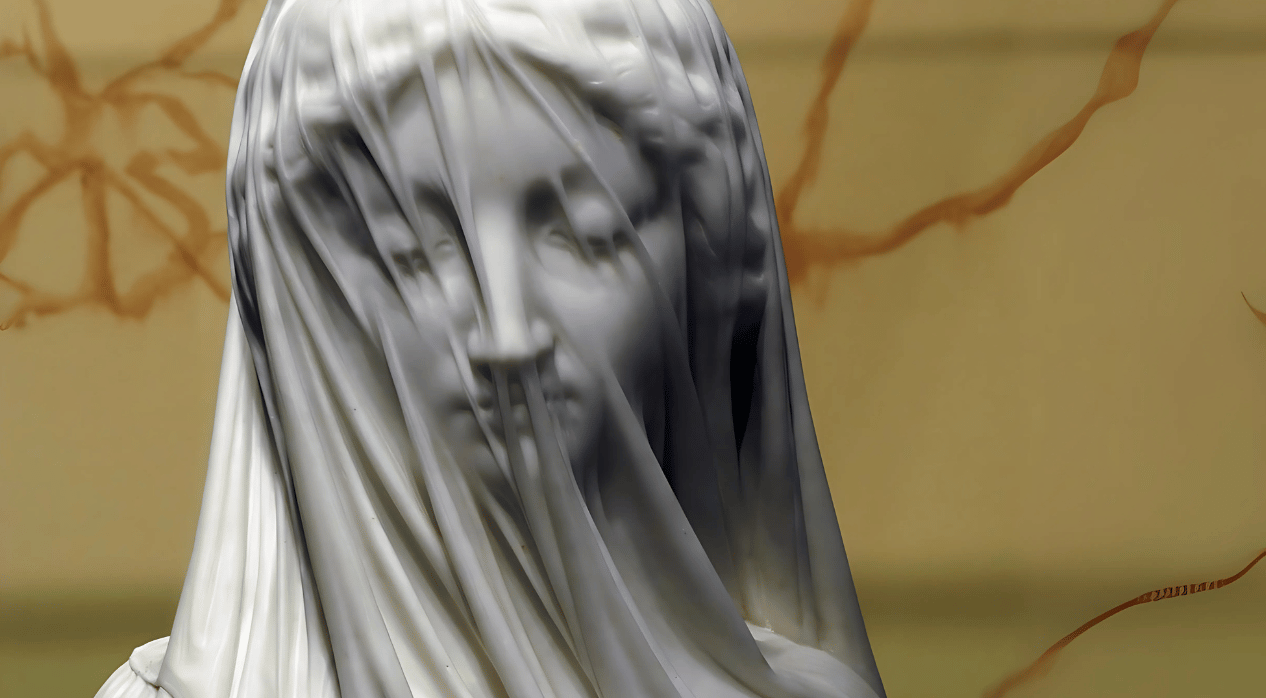
In fact it’s a question of masks. Words exist in the world veiled in both sound and meaning, and make their way among languages sometimes in one guise, sometimes another.
In fact it’s a question of masks. Words exist in the world veiled in both sound and meaning, and make their way among languages sometimes in one guise, sometimes another.
But some words pick a veil and stick to it. Attic Greek had a particularly rich vocabulary of interjections expressing grief — vocalisms that poet Eamon Grennan refers to as “acoustic units of pure feeling rather than explicitly semantic units” (Oedipus at Colonus, 31). In these words –
AI AI; E E; IO GONAI; IO MOI MOI; OTOTOTOTOTOI –
the typical relation between sound and sense is inverted. The word recedes into vocality and from there into silence, into that languageless distance that lies just beyond everything it is possible to say. I think Maurice Blanchot is alluding to this in “Le dernier à parler”, where he writes of Celan:
Ce qui nous parle ici (what is speaking to us here), nous atteint par l’extrême tension de langage (reaches us through the extreme tension of language), sa concentration (its concentration), la nécessité de maintenir (the necessity to maintain), de porter l’un vers l’autre (to carry one towards the other), dans une union qui ne fait pas unite (in a union that does not create a unity), des mots désormais associés (words henceforth associated), joints pour autre chose que leur sens (joined by something other than their meaning), seulement orientés vers — (solely oriented towards — )
Ce qui nous parle ici (what is speaking to us here), nous atteint par l’extrême tension de langage (reaches us through the extreme tension of language), sa concentration (its concentration), la nécessité de maintenir (the necessity to maintain), de porter l’un vers l’autre (to carry one towards the other), dans une union qui ne fait pas unite (in a union that does not create a unity), des mots désormais associés (words henceforth associated), joints pour autre chose que leur sens (joined by something other than their meaning), seulement orientés vers — (solely oriented towards — )
ἄγει μ᾽ ἄγει τις: ἄγει μέ τις (οὐχ
ὁρᾷς;) νεκύων ἐς αὐλάν
somebody takes me, takes me, somebody takes me (don’t you see?) to the courts of dead men
Alkestis 259-60
There is a song from the Dodecanese with the lyric Ήθελα να `μουν άρωμα που βάζεις στα μαλλιά σου / σε κάθε σου αναπνοή να μπαίνω στη καρδιά σου. In this lyric the lover wishes to transform herself into a scent, so that she might enter the beloved’s body. To want to be the air that someone breathes. Let us consider for a moment the potency of that wish.
Or is it a foolish wish? The wish of a person who is in the process of extending one foot over the edge of a cliff, his chirpy white dog egging him on.
The problem with wanting to dissipate is that one is condemned to pure potential. Immaterial. Null. Meine reine Hypothese, as I was fond of calling you (but not to your face).
Among the many translations of Euripides’ Alkestis that I have perused, there is one I haven’t been able to track down again, in which Thanatos says to Apollo: your many words are worth nothing.
          Epilogue: Ithakas
          after Konstantinos Kavafis

Δεν έχει να σε δώσει πια

Pero no tiene ya nada que darte

Nulla di più ha da darti

Il n'a plus rien d'autre à te donner

Verder heeft hij je niets te bieden meer

He has nothing left to give you now

Nun hat er dir nicht mehr zu geben

Nú hefur hann ekki meira að gefa þér

Etc.
Note: All translations are by the author, with the exception of the excerpts of Barthes’ A Lover’s Discourse, which are from Richard Howard’s 1978 translation, published by Farrar, Straus and Giroux. Oedipus at Colonus is published by Oxford University Press (2005), Une voix venue d’ailleurs by Éditions Gallimard (2002) and Άλκηστις by Cactus Editions (1992).
Sophie Fetokaki is an itinerant writer, vocalist and interdisciplinary artist. She can be found writing and reading poetry, singing folk songs, and dismantling pianos very slowly. Some of this finds its way into a PhD in music performance which she is currently undertaking at Huddersfield University (U.K.). She is also a language fetishist and inhabits a variety of language-bodies. Her first poetry book epigraphē is forthcoming in 2019 with 1913 press.
 Arcturus