
Creative Nonfiction by Francesca Dalleo
Alime and navy backpack hugging his shoulders, Reid strolls down the cobblestone walk, his knees bending like well-oiled hinges. I brace myself for my four-year-old to stop, raise his hands and plead for me to carry him. But today, he pushes forward on string bean legs, his chronic pain trailing like a shadow.
“What’s this sidewalk called again?” he asks, gripping my hand to balance on one foot, tapping the ground with the other. He looks up at me through lashes long as needles.
“Cobblestone,” I tell him.
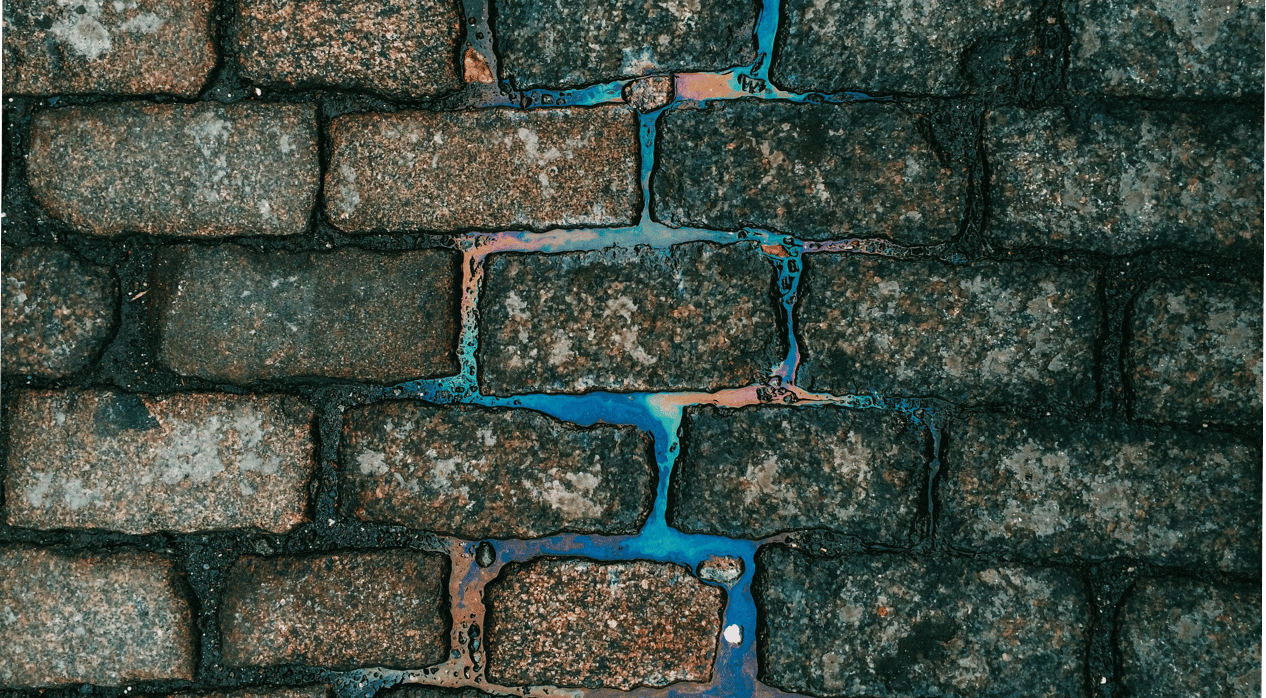
Below our feet is a rich patina of burnt sienna, rust, and burgundy. A mosaic of bricks, some lay horizontally while others are vertical. I’m told it’s one of the only original sidewalks left in our town.
On a good day, Reid stumbles only occasionally. The faster he moves, the more widely his hips swing. As for stairs, he leans forward with his hands on the steps in front of him, scrambling up to the top like a monkey. To descend, he sits and scoots his way down. It is the safest way for him, and though I wish it wasn’t so hard, I’m relieved he can get up and down at all without me carrying him.
When the pain flares, his leg stiffens straight as a fence post, lurching as if the ground itself is uneven. On the worst days, I watch him sit on the floor building cities out of blocks. Lost in play, he shifts his weight and sobs. I kneel down to wrap my arms around his and press my lips to his skin, as if I could absorb the pain.
But today, Reid doesn’t limp or shuffle. My heart floats like a balloon, his tiny hand in mine. It feels both blessedly normal and life altering to walk side-by-side down the path. I want to capture this moment — to commemorate how walking a block to school is so special for us.
I want to wriggle my hand out of Reid’s grasp, slow my pace further to let him move ahead, and slip my phone out of my pocket to record a quick video. I imagine sharing it with family and close friends with a note about how this is the first time in the year that we’ve lived here that he’s been able to walk to school. I imagine the ticker tape of supportive comments like “Way to go Reid” or “Amazing!” But something about celebrating this milestone hardens my stomach like the concrete that binds the pieces together.
“What are cobblestones made of again?” he asks.
“Bricks,” I answer.
Cobblestone is valued for its variety and diversity. The differences in the individual bricks, the uniqueness of each one, are what make it beautiful.
A few months after we moved into our house, a neighbor warned us that if we let the grass grow too long between bricks, we could be fined. I had never really noticed the grass there before, how much pushed through. One Saturday we attack with vinegar-filled spray bottles and watch the sun bleach the grass to straw. I have to wrench and dig the dried grass out with a trowel, though the vinegar loosens the roots’ grip on the soil.
I pull on one clump so hard that when it finally releases, I roll backwards, dirt spraying over me. I sit back up with the piece of earth still in my hand. I wonder what life would be like if we had smooth, uniform pavement instead. It might make some aspects easier, but I wonder if easier is always better, if we would risk losing something vital.
+I am grateful for many scientific advances, such as the test that identified what causes Reid’s leg pain that only became widely available in the last ten years. Since we learned that the cartilage in his knees was not developing typically, that the more he walks the more his bones grind at the knee joint, we’ve been better able to treat his underlying pain. What we can achieve with science today is astounding. I remember a story on NPR about scientists surgically implanting electrodes in a paralyzed monkey’s brain and body, giving the monkey the ability to walk. I picture a monkey hooked up to wires, striding on a treadmill while men and women in white lab coats jot down notes onto clipboards.
The NPR reporter explained that now that scientists have restored the paralyzed monkey’s control of its legs, they ultimately hope that the research could be applied humans, to help paralyzed people to walk again.
I remember our first day at the new playground just outside of our neighborhood, the one with the narrow blue staircase flanked by lime handrails on either side. Reid hobbled right over to the steel structure. He grasped one hand on the left and the other on the right, the dual handrails providing enough support that he strode up the stairs, upright, by himself.
His lips pursed in concentration as he descended on foot. Before the last step, he pushed off the handrails, lifted his body into the air and kicked his legs out like a gymnast on parallel bars. During this celebratory gesture his eyebrows arched up before he stuck the landing.
That day he practiced ascending and descending the stairs on his own again and again.
When we hear about the monkey re-learning to walk, we might simply be impressed by the medical breakthrough, the scientific progress. We might celebrate the triumph of ‘fixing’ the primate. But for me, the experiment is more complicated, more nuanced.
Reid could use narrow stairs with handrails on both sides more than he needs electrodes implanted into his body. Even on a day when his knee wouldn’t bend, the staircase’s design made all the difference in helping him. What he needs is accessible sidewalk ramps cut out of curbs more than a miracle drug or cure. I wish that researchers would devote as much time towards adapting and updating environments as they do to trying to change the people themselves.
As we near the preschool’s entrance, my window to take a video of Reid walking by himself to school narrows. I decide to keep my phone in my pocket, his hand in mine.\
“They put the brick into fire, right?” he asks.
“They put the clay into a kiln,” I say, “and the fire turns it into brick.”
The clay is dug from the earth, molded into blocks. The fire hardens them, makes them stronger, transforming the soft clay into bricks.
On the same path on a different day, we meet an older boy from school and his mom outside of our house. Reid is feeling too stiff to walk, so I lug the stroller down three steps from our front porch ready to head to the playground.
As Reid hops in, the boy laughs and taunts, “Babies ride in strollers.”
“Eric,” his mom says, “you ask to ride in the stroller all the time.”
I sputter something about how Reid uses the stroller because his leg hurts sometimes, but before the words reach the other boy’s ears, he is sprinting up the block. It’s the not the same, and we all know it.
Cobblestone is quaint and lovely at first glance. But in truth, it’s a bumpy, beautiful tripping hazard, a relic of the times when people with disabilities were institutionalized, abandoned, and hidden away.
For months after the boy teased him, Reid refuses to ride in the stroller. On our five-block walk to the playground, Reid limps next to it, alternatively clutching the side for support or stopping and asking to be carried. I beg him to get in.
“I don’t want the other kids to think I’m three,” he says.
By the time we get there, his knees are stuck, frozen in extension. Instead of climbing or playing hide-and-seek with other kids, he sits on the bench or swings by himself. We leave after a handful of minutes.
Days later, when the number for Reid’s preschool appears on my phone at work, my stomach tightens. His teacher tells me that he fell on their walk around the block. He cried hard. It was the only time he had ever cried in front of her. She said he seemed to be in pain but refused to ride in the stroller we leave at school. He told her, “The other kids say that babies ride in strollers.”
When Reid gets home I run the bath until steam fills the room, his skin pink. He says, “Look Mama, I can bend again!” His legs form mountains, and I exhale.
Cobblestone changes over time. Discordant bricks crack and crumble. Some split clean in half; the sidewalk buckles. Some might say this weakens it, but I believe the imperfections give the stone its character.
After months of arguing about the stroller, Reid and I develop a system. He rides in the stroller to the playground. When we get there, we park it outside. He hops out and walks through the gate on his own. If it were my choice, he would proudly ride all of the way in. But it’s his decision.
We’ve come to rely on many means to travel long distances — a wagon, scooter and a child-sized, silver walker.
Reid is learning to navigate an uneven path. I am learning that the goal is not always faster. That can better be achieved through different means. I hope that my son can be seen and accepted for who he is, rather than for what he is not. At times his biggest challenges come not from his legs, but from the expectations of others.
Some days, my five-year-old asks to ride in the stroller. “I want to save my energy for the playground,” he says.
Though my legs strain and back twinges as I fight the wheels over an undulating carpet of bricks, my body and soul lift. The ground beneath us is born from fire, both pockmarked and dimpled, broken and beautiful.
Francesca Dalleo has over a decade of experience writing and editing for nonprofits. She holds an MFA in creative writing from George Mason University and a bachelor’s degree in English and Psychology from Georgetown University. She has essays appearing in Mothers Always Write and MUTHA Magazine, and forthcoming in The Sunlight Press.
 Arcturus