
Creative Nonfiction by Adriane Brown
Ihaven’t always been a senior. Even though I suddenly find myself checking that box, I don’t see myself as the kind of senior you’re thinking of, creeping along the sidewalk, unkempt gray hair falling in my face, taking cautious, tentative steps as I wobble along with my cane. Although I retired this year after thirty years of teaching in the public schools, I bike ride, play pickleball, and do Zumba when the gym is open. And although you may not be a senior, I have been your age, so I actually know more about you than you think, and I certainly know more about you than you know about me.
I was an infant once, colicky and wearing diapers that needed to be changed regularly, crying loudly at the smallest slight. When I was born, the doctor informed my parents that I probably wouldn’t live twenty-four hours, so they did what any good parents would do. They found another doctor, who informed them that I was fine, a colicky but feisty baby. Mommy and Daddy loved me despite those major faults, and when they became colicky in their later years, complaining loudly at the smallest slight and facing the possibility that they might eventually need diapers, I returned that love, working exhaustively to help meet their needs as they worked for so many years to meet mine.
I was a child for a while, struggling to make sense of an often incomprehensible world. Nuclear war was the terror of my childhood. In this hellish scenario, the Russians, our favorite enemy then, would fire nuclear weapons at our country, and we Americans would retaliate, of course, bombing them in return. It was predicted that no one would really survive this disaster. The United States would become an uninhabitable desert, leaving anyone who survived to die slowly from radiation poisoning. Nuclear radiation would spread everywhere, leaving the rest of the world a wasteland also. We knew that two of these atomic bombs had already been dropped — on Japan at the end of World War II, leaving hundreds of thousands of Japanese people dead or horrifically damaged from radiation poisoning. Of course, that was something that had happened in another era, the childhood and young adulthood of our parents’ generation. Still, it could happen in our country too; so many far fetched and strange remedies were put into place to keep us safe and healthy.
Fallout shelters, concrete bunkers built into the basements of many public and private buildings, were produced across the country. Large black-and-yellow Fallout Shelter signs were posted on these buildings, visible for everyone to see. I was always curious as to how a person got into one, who was allowed in, and how they would fit everyone inside when the bombs started falling.
Designed to protect us from a nuclear attack, they had concrete walls and were stacked with supplies such as survival biscuits and barrels of drinkable water. The shelters contained portable toilets and first aid kits with supplies such as cotton swabs, tongue depressors, and other things that would be useful during a nuclear attack. Some were built in the basements of public schools, and in 1963, Gordon JHS in Washington, DC, had sixty-two students stay in a fallout shelter for thirty-six hours to test it out. Another bunker was discovered underneath Oyster-Adams elementary school, also in Washington, DC, and is still there today, untouched.
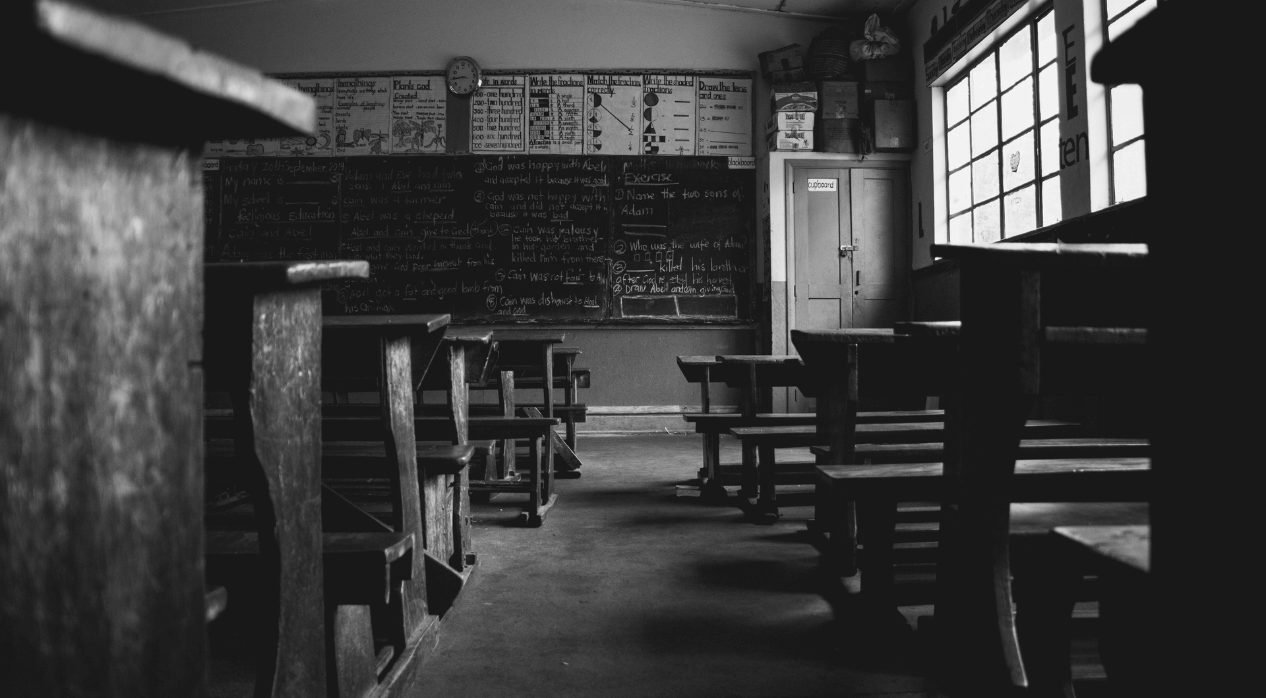
Those of us who were not chosen to test out the nuclear fallout shelters were subjected to regular drills in school, during which a siren or alarm would go off and we would crawl under our desks for protection, our hands clasped on our head. Duck-and-cover drills, they were called. I was never clear on how hiding under my desk would protect me from a nuclear bomb. As I crouched under there, I thought often about what it would be like if that happened, and whether I would be crushed by the desk collapsing on top of me. I don’t remember ever having a discussion in class about nuclear war or an explanation as to how crawling under the desk would help us to survive. It was just part of the school routine, and we were expected to follow it.
Fast-forward a few years — we grew older, becoming teenagers and young adults, and were told once again to follow obediently, this time to become the primary combatants in a faraway country, in a war that was not of our making, being conducted for reasons that were as incomprehensible as the duck-and-cover drills. This time, some of us obeyed the orders, as we were taught, but many of us refused, and became central to the anti-war movement and the anti-nuclear movement (yes, there was one, a very active one). You really can’t fool kids, and sometimes I think about all of us baby boomers scrunched up under our desks, perplexed as to how this would protect us from a nuclear attack. There never was a nuclear war, and I do believe that our later protests had something to do with that.
Today, kids sit in lockdown in their classrooms during active-shooter drills, and during the COVID-19 pandemic of 2020, they have no school at all. These days, many of us even talk to them and try to explain what is happening, trying to help them understand the strange events that are occurring without terrifying them. Don’t let them fool you, though. They’re watching and thinking and forming opinions about all this, and in a few years, they will be out there, demanding real solutions.
As we protested and marched against war in the 1960s and ’70s, we were often ridiculed, called communists and spoiled brats. The Vietnam War was happening in someone else’s country, but it was our generation that was sent into combat — our brothers, cousins, friends, and peers. The older generation, with some exceptions, could not figure out why we were taking these stances, and often attributed our anti-war fervor to cowardice. What they didn’t get was that we were the generation that was required to curl up under our desks, waiting for the world to be obliterated. Sent under there by adults whose inability to create a cooperative world, where everyone could live in peace, created this scariest of situations. And when we got old enough for them to demand our allegiance to their war in Southeast Asia, another of their crazy, violent schemes, we remembered, and many of us refused this time. Believe those crazy adults? Never! Cowardice? No, the highest form of courage — to be able to stand up and fight back against those powerful, scary forces. Obedience? Our choice was to obey, to show our loyalty to our country by bombing and killing an innocent population, obliterating their homes and villages, killing their children, just as those nuclear bombs we hid from would have killed us and obliterated our homes and cities. We might also be maimed or die in combat ourselves, and if we resisted, we faced jail sentences. Eventually, the lines began to cross, and soldiers became resistors, and resistors supported the soldiers and found creative ways to stay out of jail.
No wonder we trusted the Beatles more than we trusted the government.
During the terrible pandemic of 2020, wearing masks is an attempt at survival, at fighting back against an unseen enemy. I tried to remember if there was ever a time when I had to wear a mask to survive. I couldn’t think of any, but then I remembered our anti-war protests. May Day, 1971, when young people protesting the Vietnam war converged on Washington, DC — thousands of young people wearing masks and face coverings to protect us from tear gas. Not necessarily lethal immediately, unless you had asthma or a lung problem, or it got into your eyes, which weren’t covered. Tear gas that could cause coughing, difficulty breathing, pain in the eyes, and temporary blindness, paid for by our tax dollars.
There never was a nuclear war, or was there? As we approached our teens and twenties, we learned that our government continued to explode nuclear devices, test runs for the real thing. The radiation from those test explosions was carried through the air, in the spring breezes and the winter winds, contaminating the air, the groundwater, and the food chains across the country. And as we got older, the number of cancer cases also exploded, touching everyone in some way. Current projections show there will be eighteen million cancer survivors and 630,000 cancer deaths in 2020.
Now in my senior years, I find myself in another terrifying situation, a pandemic that is incomprehensible and inhumane, being forced to rely on a clueless president and the sycophants who support him. It is outrageous that a two-trillion-dollar bailout does not include enough support for medical workers and hospital employees to be able to wear sufficient protective gear, and to provide workable medical equipment to save all of the lives that can possibly be saved. As incomprehensible as crouching under a desk to survive a full-scale nuclear war.
Where have we gone wrong, that we are still facing these absurdities after sixty to seventy years of living with them? Of course we should sequester ourselves and wash our hands, avoid situations where the disease can be spread. We have always stayed home when we had a cold or the flu, drinking fluids and staying in bed. This time, the disease has become much more serious, raining death and chaos in our communities. Nuclear war certainly would have done that, if there were any communities left afterward. We fought and fought against the policies that would have led us there, with some success. No nuclear war, but other pandemics threaten us now.
Maybe some of the fight-back of the past fifty or sixty years has been misguided. Many of us who grew up excluded from the elements of mainstream success have fought endlessly to be included in those sparkling boardrooms, in the white, male, corporate world. No reason why we shouldn’t, if that’s the key to survival in America. But maybe there is something wrong with the way corporate America functions in the first place, and maybe we need to start using a different approach, because that system is killing us. A system based on competition, individualism, and getting what you need with no regard for the survival of other people or for the earth is not working for us. All our effort to be included, and as of this writing, thirty million people have no jobs at all.
How do we stop letting the corporate elite set the rules for us, stop them from being the sole determinant of whether or not we survive? How do we develop a new plan — a blueprint for a society that is inclusive of all people and is based on cooperation and community, rather than competition, aggression, and war? We have made some progress in the past sixty years, but some of the most serious things haven’t changed a bit. Developing a new plan, a new direction, is a process that will take time, cooperation, and innovative, clear thinking. How do we work together without competing for whose ideas are best, without attacking each other for not being perfectly correct all the time?
So, a two-trillion-dollar bailout does not include enough medical supplies to provide healing for our sick. After surviving the possibility of total nuclear annihilation, a war which killed fifty-eight thousand of our peers, and hundreds of thousands of cancer deaths, those of us who are classified as seniors are now finding that grocery shopping is more terrifying than any of them, that going to the park is life-threatening, and that hugging people we love, or even being in the same room with them, is risking death.
The latest debate is so shocking that it took my breath away. I’m hearing that when hospitals are critically overloaded, decisions may have to be made as to who gets the supplies that they do have, and who may have to be allowed to die as a result of the shortage. The answers are similar to those that existed during the Nazi era in Europe. Who will be allowed to live, and who will be the first to be shot or thrown into ovens? Well, those who are able to provide the labor to keep production running would be allowed to live, and those not contributing to the economy, especially the elderly and the disabled, would have to be sacrificed for the good of the country.
Despite my age, I do not have COVID-19, but if I ever do, I would rather die at home than allow some stranger to decide if I am worthy of being treated.
For now, I’ll just sit under my desk and contemplate the insane policies that have led us here. Someday, when I’m allowed out, I’ll fight against them with all the energy I can muster. And I’ll put my trust in the kids.
Adriane Brown attended the Washington Review of Books “Books Alive” Conference in 2017, and she attends the Maryland Writers’ Association annual conferences as often as possible. She also participates in the Montgomery County chapter of the Maryland Writers’ Association and has taken dozens of writing classes at The Writer’s Center, Bethesda. She has a master’s degree in special education from San Francisco State University and a bachelor of arts degree in liberal studies, and worked as a teacher for thirty years. She enjoys socializing with friends and family, bike riding, pickleball, Zumba, and political activism.
 Arcturus