
Fiction by Cathy Adams
The card was stuck between the pages of Catcher in the Rye, a book Sessie had picked up in a used bookstore in Nashville. It was a key-card, the kind employees use for security access into buildings, with slightly raised letters in blue and red: Bank of America, Manhattan Headquarters. Suresh Beheras. She whispered his name, the consonants fighting for dominance on her tongue. Sessie held the card in one hand and the book in the other. “I wonder if he liked it.”
“Liked what?” muttered Rae.
“Salinger, I wonder if Suresh Beheras liked Salinger. He left his I.D. card in this book.” She tapped her nail on the cover. Their DMV salaries allowed them the luxury of eating lunch out only on Fridays, so Sessie had eaten nothing but the dregs of a bag of puffed rice and leftover pieces of a sesame bar from her purse. Despite her meager meal, she wasn’t hungry. She clutched the keycard. “He must have been really taken with this book to leave his key card in it as a bookmark. You don’t stick your key card in just anything. You have to be really into a book to leave something that important in it.”
“Maybe the card was old. Maybe he quit his job and tossed it in a drawer, and when he needed a bookmark one day, there it was.”
“When you quit jobs you have to give your key card back,” said Sessie.
“Or maybe he got fired. And he was so mad he told them he’d lost his card, except he stuck it in that book and dropped it in the Goodwill bin just to stick it to the bank. That’s what I’d do. Which one was it again?”
“Bank of America,” said Sessie, luxuriating in the pronunciation of the last word. She ran her finger around the edge of the card again and studied Suresh’s face. He looked like a man who shaved at 6:00 AM and had a five o’clock shadow by lunchtime. His hair was short, neat, and cut to minimize its glossy fullness. He wasn’t smiling, and he looked tired, his hooded lids hanging like café awnings at the outer edges of his eyes. Suresh worked a lot of hours; Sessie was sure of it. She couldn’t believe anyone would fire a hard-working, loyal employee like him. He probably left his key card in the book one night when he was reading, too tired to get up and search for a book mark. Maybe the book with his key-card stuck inside was stolen on the subway and ended up in a donation bin after the thief finished the book. Or maybe Suresh himself had gone to Nashville on business. Bank of America business. Maybe he lay on the hotel bed after a long day of meetings about bank stuff. He was spent, sweating from the blistering Tennessee heat, reading Catcher in the Rye. He was moving up in the company.. He wanted more than Manhattan. He wanted adventure, the love of a good woman, his own F-1 racecar. Sessie rubbed the card vigorously between her hands. “I’m going to return it to him.”
“What? How?”
“I’m going to find him.”
“Find him online. You could overnight it,” suggested Rae.
“No, I mean I’m going to take it to him myself. Right to the bank. And I know what I’m going to say.” Sessie reached for her purse and put the card safely inside. “Any man who has a job at a big Manhattan bank and reads Salinger is a man who’s got himself together. He’s a man worth getting to know.”
Rae swallowed hard and took a drink of her orange soda to wash it down. “You’re going to Manhattan? That’s nuts. You’d have to take off work. You’d have to fly.” Rae flipped her hand in the air. “That is such a crazy idea.”
“It’s not crazy. This is fate,” said Sessie, and she meant it. Fate threw her a curve when she found six Suresh Beheras in New York City. One was an eighty-year-old retired ophthalmologist, one had recently died, one worked for an industrial cleaning company, and oddly, the remaining three all worked in finance. But whichever one he was, she knew her starting point was the bank.
For Sessie, calling out sick from work on an August Friday in Knoxville, Tennessee, to fly to Manhattan was like shedding her clammy skin and slipping her arms into butterfly wings. Sessie’s flight left at 11:30 AM, and while her work friends were waiting for their sandwiches and fries at Chili’s, Sessie was ordering white wine on the flight, a luxury she’d seen in movies but never dreamed she would indulge in. She imagined Suresh drank wine when he traveled for Bank of America. Or perhaps he drank beer. She slipped the card from her zippered pocket and studied it once more. Smiling out the open window, she took another sip. No, he was definitely a wine drinker. Probably red wine. Cabernet.
“Your boyfriend?” Her seatmate pointed at the key card. She looked to be in her sixties, with rose high-lights in her gray hair that fell around her face in nineties style waves.
Sessie instinctively pulled the card to her chest and covered it with her hand. “Oh, fiancé actually.”
The woman’s eyes roved over Sessie’s naked hands. “Well honey, let me give you some unsolicited advice from a woman whose caboose was traveling the tracks before you were born. Get the ring.” She tapped an age spotted index finger on her left knuckle. “Nothing less than a carat is my rule.”
“He’s saving up. He works for a big bank in New York,” Sessie replied.
The woman shrugged. “Then go for two.”
Sessie turned her face to the window and didn’t say another word until she got to LaGuardia.
Manhattan’s Bank of America building was not just a Bank of America building. Sessie had never seen a bank with so many other businesses glommed onto it. Standing against the glass wall next to the entrance, she pushed her hand inside her coat pocket and ran her finger over Suresh’s unsmiling face. She’d worn her navy suit, the one she’d worn for her interview at the DMV, and her only real gold jewelry, a bracelet her parents gave her when she graduated from Nashville Technical College five years earlier. Everyone seemed to have some place to go and was in a big hurry to get there. For a moment she wanted to find a restroom where she could run inside and hide. She took a breath and clutched at her waist protectively, a nervous habit she’d long had. “This is just a starting point,” she whispered to herself. “Go, go.”
The young receptionist’s eyes ran up and down her clothes so quickly Sessie hardly caught it. “How may I help you?”
Sessie pushed her words out with a pleasant uplift at the end. “Yes, I’m looking for Mr. Beheras.”
“You have an appointment?”
“Actually, no. I just need to speak to him for a moment.”
The receptionist clicked at her screen for what seemed like a suspiciously long time.
“B-E-H-E-R-A-S.” Sessie’s southern accent dripped through the letters and the receptionist suppressed a smile.
“I’m not seeing anyone by that name in our directory.”
“Suresh Beheras,” said Sessie, but there was no response from the young woman behind the desk. “He may have recently departed. I mean, he’s not dead. But he may have left the company. Do you have a list of former employees?”
The young woman’s eyebrows bunched closer together in the middle. “You want a list of who doesn’t work here?”
Sessie pushed her hand into her pocket for strength. He was still there. “I just need to see him. To speak with him.” She lowered her voice. “We met at a um, a conference three months ago. A banking conference in Tennessee, and now I really need to talk to him.” Her stomach was cramping. She took her hand from her pocket and held her abdomen.
“Oh. Ohhh.” The tone of the young woman’s second word sank in communal understanding. “Three months?” It shrunk to a whisper and she nodded. “Give me a minute, okay?” More clicking, this time faster. Her eyes flipped back and forth across the screen for a full two minutes as she worked. From the front doors a cluster of neatly suited men and women approached with polished shoes that clicked on the white granite floor like a bag of nickels being dropped. The receptionist threw them a big smile and exchanged polite nods as they passed and continued toward the elevators. Returning to her computer, she leaned back in her seat, glancing around casually before she spoke. “I don’t think a trip to New York City would be complete without sampling the Biryani Pot. I think you’d really like their food. Here’s the address.” She scribbled on a Post-it and placed it on the counter. Sessie thanked her and mouthed the name to herself a few times before sliding the paper into the pocket with the key card. She felt it stick to Suresh.
Unlike Nashville, there were no trees anywhere on Mulberry Street, and some of the business signs were written in other languages. It was nearly one o’clock and only three people were eating in the Biryani Pot. The menu had a greasy handprint in the center, covering the naan options, Sessie’s favorite Indian food. Her stomach had stopped hurting after she left the bank, but now it was empty. The server who came to take her order held her cell phone, patiently waiting for Sessie to choose from the specials. Sessie made her choices and smiled politely, though the woman did not smile back. Chicken Fry Biryani, for One Person. Spiced Chai. No refulls.
A glance around the restaurant told her Suresh was not here. One older lady dressed in a dark purple sari sat behind the cash register, and one other waitstaff delivered a basket of naan to a man in a gold t-shirt and knit cap that barely held his dreads. Sessie slumped in her seat. Maybe the receptionist really thought she would enjoy a meal at this second-rate restaurant. Maybe she took one look at Sessie’s Ann Taylor suit and Tennessee Republican lady hair and pegged her for a weekend tourist who’d had one too many wine spritzers at a convention and thought she’d track down her one night stand all the way to the Big Apple. Her flight left at six AM Sunday. Perhaps the biryani would live up to the receptionist’s hype. The trip had required two bus transfers across town that she’d had to navigate with Google Maps. She wasn’t likely to see much of the city that would make the trip worth the chunk of her paycheck she’d already sacrificed. She held the keycard in front of her like a pocket watch. She tilted it toward the sunlight coming through the window, sighed, and dropped it on the table. Taking her phone from her purse, she pulled up the first of the three Suresh Beheras who worked in finance. A subway ride across town to a small investment firm. At least it would be easy to get in.
She was memorizing the street address when the young server slid her biryani and chai onto the table and was about to drop a napkin wrapped fork next to it when she suddenly. “What are you doing with Suresh’s card?” she asked, air jabbing a finger at the card.
Hearing his name startled Sessie. She’d never heard anyone else speak it aloud. It was oddly personal, hearing it in someone else’s mouth. “What? What did you say?” Sessie sputtered.
“That’s Suresh. My uncle. What are you doing with that card?” The server’s voice turned hard, suspicious, as if she had stumbled onto an awful mystery, and her pointing, accusing finger remained in firing position at Sessie.
“Oh. Oh! You know him! You know Suresh.” Sessie nodded her head trying to collect her thoughts. A confrontation with a waitress was not in her plans. She grabbed the card and held it between her hands. “I came all the way here to bring this to him. I found this in a book. A J.D. Salinger book, and I wanted–. Do you know where I can find him?”
The woman stepped back on one foot as if she’d spotted something disgusting about Sessie. For a few moments, she sized up the sweaty woman in the cheap suit, and then finally, she must have determined there was no threat. She shrugged. “He’s in the kitchen.”
Sessie watched her walk past a row of tables and go behind the counter. The animated conversation she began with the old woman in the purple sari was loud enough to hear, but they were not speaking English. The two women shot glances back at Sessie as they talked. After some animated gestures with a single, heavily ringed hand, the old woman stood up from her stool with some effort and disappeared through the kitchen door.
The biryani bowl sat steaming on the table. Sessie toyed with the idea of politely approaching the women with her story of seeing Suresh’s face looking up at her from the pages of the Salinger book and how she felt fated to find him for reasons she could not explain, but thinking about it in this place, the story seemed faulty her, as if there was some part she couldn’t see clearly. Before she could make up her mind to go after either of the women, a man in a white apron came ambling through the kitchen door. He paused and, in no hurry, untied his apron. Folding it four times neatly, he placed it on the counter and made his way toward Sessie.
He was taller than she’d imagined and a little older. He’d lost weight since the I.D. photograph had been taken. Handsome in a tired, mid-life kind of way when men settle into their bodies, his eyes were ringed underneath with bags and his brows hung full and black over his dark eyes. They were the one part of his face that had not changed at all. He moved with deliberation, like a man who thought carefully about what each part of his body was doing at any given moment. His own face on the card stared upward.
Sessie’s face broke into a tense little smile. “J.D. Salinger sent me.”
Suresh didn’t speak, but he raised his hand toward the card for a second and then lowered it again.
“This is yours,” said Sessie. She thrust the key card at him and watched his eyes lock onto his tiny face in the square. A ripple of a smile flitted across his lips, but it disappeared so quickly Sessie wasn’t sure what she’d seen.
“Where did you get this?”
“I found it in a book. Catcher in the Rye. I picked it up in a used book store. Amazing, right?”
“Did you bring the book?” he asked, looking up from the card. “The book’s more important than the card.”
“Oh, uh, no. I didn’t bring the book. I should have brought it, too. I’m sorry. I thought you would want the card back, for your job, but they said you didn’t work there anymore.”
His eyes tightened a little and his face grew concerned. “You went to the bank?”
“I thought I might find you there, but you weren’t there. I mean, of course you know that.”
He eased himself onto the seat across from her without asking. The motion seemed natural, as if that one and every other seat in the place belonged to him. “It’s been four years since I worked there.”
“And now you have your own restaurant. That’s, that’s really good,” said Sessie, making a concerted effort not to eye the nearly empty space.
He laughed. “This isn’t my place. I don’t even work here. Not really. It’s my sister and her husband’s place, but he got deported thanks to President Asshole. So I’ve been helping out on my days off.”
“That’s awful. I’m so sorry,” she said. “I mean about him being deported.”
“Me too. I can’t cook worth a damn.”
She looked down at her biryani, which she had yet to taste. “It’s really good,” she said, taking hold of the clean fork from the napkin.
“So,” he began, clasping his hands together on the table. Something about it made Sessie think of a therapist or a priest. “Why did you come here? You didn’t really travel all the way across town just to give me back my card.”
Usually when a relatively strange man pushed into her space it signaled alarm bells, but this was Suresh. She told herself she practically knew him. After all, they’d shared J.D. Salinger. “I didn’t come across town. I flew from Nashville, Tennessee, to give you that card.” As an obligatory act of politeness, she took a bite of the biryani and nodded appreciatively as she chewed. “Like I said, I found it in my book. Catcher in the Rye? You must have been reading it when you left the bank because it was stuck inside. The card was between pages 119 and 120. I’ll never forget what it said. Do you remember?” She waited, expecting him to trot out the words, any of the words. She wanted him to show that the man she thought she saw in the picture was the one her brain had conjured up.
“Sorry, no. I don’t remember anything from that book.”
“When you’re feeling very depressed, you can’t even think. That was on page 119. That’s one of the lines that stuck with me,” said Sessie.
Suresh shook his head. “You came all the way from Tennessee because of that book. And you memorized the page? I don’t understand.”
She took another bite of her food mainly to give herself a pause before she had to answer. Wiping her lips with the paper napkin, she put down her fork and replied. “I don’t really understand it myself. I guess it was kind of a lark. You know, like one of those ideas you get in your head, and it sounds good at the time you think of it. So you tell your friends at work and it just sounds cool and adventurous and maybe a little crazy to them, but to you it sounds like something you were meant to do and you can’t explain it. Like something Holden Caulfield would do. Oh wait! Like something he actually did do. He went to New York City. You know? In the book.”
“I don’t think he ever worked at Bank of America,” said Suresh.
Sessie gushed with laughter. The server and the old woman peered at them both from behind the counter. “Let me tell you something. Maybe it will make sense to you, and maybe,” she pinched her eyes shut and shook her head trying to clear it before continuing. “Maybe you’ll think I’m crazy. I work at the DMV in Nashville, Tennessee. I’m a control cashier. I look at a zillion pieces of paper every day. I help people fill out forms. I answer questions. I’ve been doing it for four years, and about the only thing I can say is that it pays better than waiting on tables at Olive Garden, and I’m not on my feet all day. And some days I get ideas that there’s something better somewhere. There are people out there doing bigger things and getting paid better money than me and living interesting lives. Like maybe a big bank job in New York City. And they even read J.D. Salinger.” She sighed in awkwardness at how her words sounded. Her presence there suddenly felt absurd, even a little offensive. “I’m sorry I wasted your time with the key card. I just imagined you wanting it back, and I took off to return it to you before I had a chance to change my mind.”
Suresh reached out with both hands and gently pushed the plate an inch or two closer to Sessie. “Finish that mediocre lunch, and I’ll show you who I am.”
The bus took them to 14th street but the remaining walk was enough to grind a line of rice-sized blisters onto Sessie’s third and fourth toes. Business signs were in English, and there were fewer outdoor cafes. No one stood in doorways or sat in chairs on the sidewalk reading their phones. “Is this where you live?” asked Sessie, limping beside Suresh who pressed onward in confident strides.
“No, I live in the back of the restaurant. Saves money.” Sessie had a dozen questions to ask, but she had no chance to begin. Suresh stopped and pointed up at a modest sky scraper with scaffolding scrawling up one side.
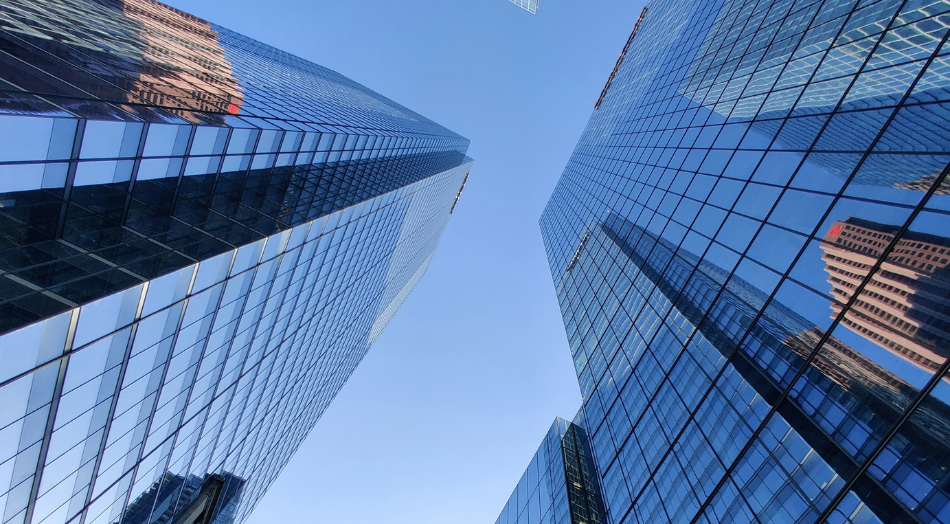
Del Valle Center. The letters were enormous boxy black shapes over the entranceway. Nowhere as tall as the Bank of America building, it made the Nashville DMV look like a Dollar Tree. Sessie leaned back and shielded her eyes to make out the roofline that faded into the silvery blue afternoon sky.
“This is where I work right now,” said Suresh with evident pride. He took in a deep breath of air in much the same way Sessie did when she and her cousins went hiking in the North Carolina mountains, but the city air of New York smelled nothing like any air she wanted to breathe deeply.
“You work in insurance now?” The sign inside the doors, high above the front desk was printed in blue scripted letters, Whelan and Panitza, Insurance Inc.
“Not inside. Look up,” he pointed straight up the building. Barely within clear sight, a wide, narrow box hung from the building. Attached by what looked to Sessie by only ropes and pullies, two men stood in the waist-high container, cleaning countless rows of glass windows. “That’s why I left the bank.”
“I don’t understand,” said Sessie.
“I worked on the 18th floor for six years. I also looked at forms every day. Except my decisions didn’t cause mere inconvenience; some of them ruined people’s lives. During Covid, I seized assets of people who had been too sick to work. People whose spouses and parents died. We took houses, cars. Credit was ruined. But it wasn’t just during the pandemic. I’d been doing this for years, and I made good money. We had a formula that set the answers for us, but computers don’t make decisions. People do. ” He turned to Sessie. His body sagged forward, and his hands pressed hard onto his thighs. “This is how it ended for me. There was this one guy who’d been really sick in the hospital. I’ll never forget him: Angel Poppas. He was one of the lucky ones because he made it off the ventilator. He had a good job before he got sick, but he fell behind on his mortgage, his homeowner’s insurance, his property tax. This guy owed everybody. He had no family, nobody to step in and fill in the gaps. After a few months he was getting back to work part-time, but he was too far in arrears. I pulled every lever I could for him without getting myself fired. Fuck! I talked to him so many times on the phone. Always asking us to give him more time. Just another month and he’d get caught up. He’d go on and on, just talking like he knew me. One day he started to cry. By this point I knew what the bank was going to do. His loan. Him.” He shook his head, remembering. Sessie waited patiently for him to continue. He stared up at the window washers pulling their squeegees across the glass, and soon the look of calm placidity returned. “You know what we were instructed to tell people? ‘We have no choice.’ That was our preface for everything. We have. No. Choice.”
“So what happened to him?” asked Sessie.
“His electricity got turned off. He froze to death sometime in early January 2021. Nobody found his body until about a week later. And, the bank got his place, just like I knew we would.”
The window cleaners lowered their car and began squeegeeing a new row. “I lied when I said I didn’t remember anything from the book. There was one line. All morons hate it when you call them a moron.”
“I don’t remember that one,” said Sessie.
Suresh nodded, his eyes following the movements of the window washers high above. “That was what I said the day I quit. Holden Caulfield’s words. And now this is what I do. I clean windows just like the guys I used to watch when I was stuck inside the18th floor. Maybe one day I’ll clean the big Bank of America building’s windows. Wouldn’t that be something?”
Sessie clutched the key card, unsure what to do with it.
“You can keep that. As a souvenir of your trip to New York,” said Suresh.
She wasn’t sure if he was kidding. “Thanks,” she said and hurriedly shoved it into her purse. “I don’t think either of us needs it now.”
“I’m sorry if your trip wasn’t what you hoped it would be.”
The afternoon wind was picking up and it tossed Sessie’s hair into her eyes. “Maybe it was.”
“You know, this is the first time anyone’s come to find me. For any reason. I’m not sure why, but I guess I should thank you.”
The two of them stood, obstacles among passing pedestrians on the sidewalk, watching the window cleaners. Sessie tried her best to think of a line, the right line from Holden Caulfield, but none came to mind.
Cathy Adams’ latest novel, A Body’s Just as Dead, was published by SFK Press. Her writing has twice been nominated for a Pushcart Prize. She is a short story writer with publications in The Saturday Evening Post, Utne, AE: The Canadian Science Fiction Review, Barely South, Five on the Fifth, Southern Pacific Review, and 72 other journals from around the world. She earned her M.F.A. at Rainier Writing Workshop, Pacific Lutheran University, Washington. She is a faculty member at the American University in Bulgaria.
 Arcturus