
Creative Nonfiction by Mina Hamedi
My mother was afraid of the night. Sunsets would make her nervous, so her aunt would take her on long walks around their neighborhood in Istanbul to distract her, to show her a place outside home.
|
|I prefer the night. I imagine I’m the only one awake, watching the city from my bedroom window in New York, thinking of all the things I can do before the sun comes up.
Part I.
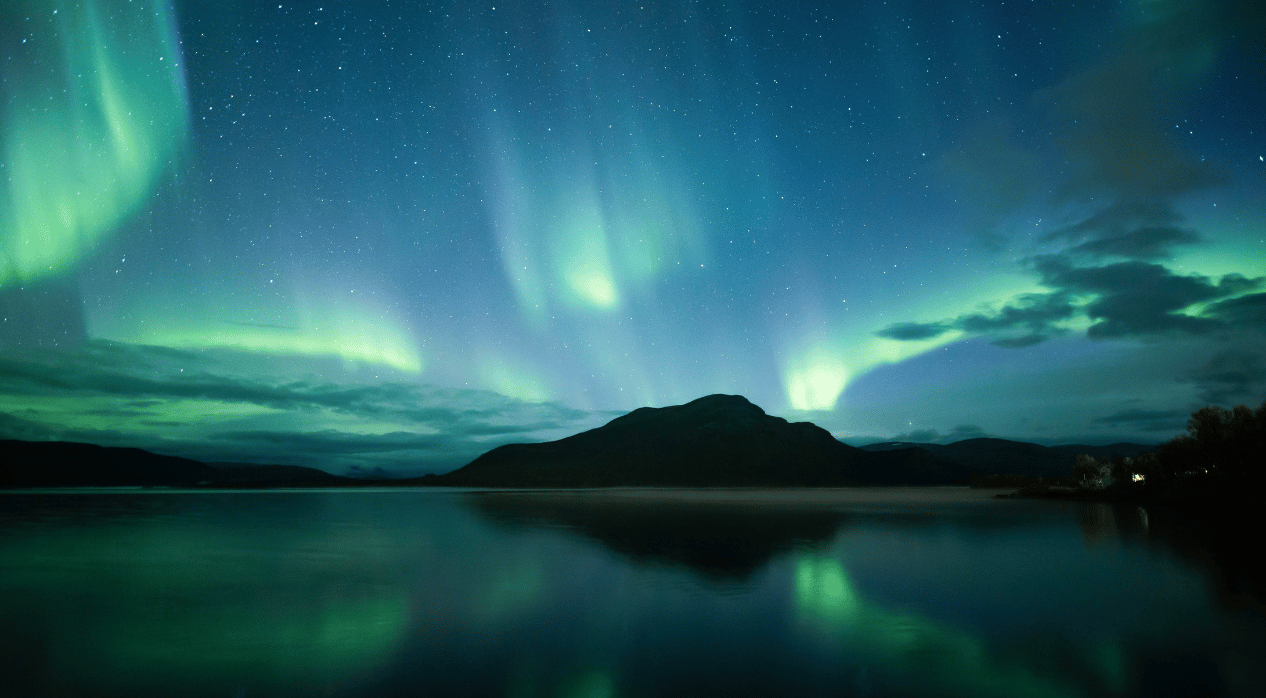
I was told the sky was just a layer arching over the Earth. There is a hole in the atmosphere, a pathway from our skies into the outer dimensions. This path is lit by the Aurora Borealis.
The Saami believed that when these lights rippled in the sky, people had to be respectful; they could neither wave nor whistle because spirits might snatch them up from the ground. The Eskimos of Eastern Greenland whistled to bring the lights closer, to whisper messages to their deceased loved ones. The natives of the Arctic regions of Finland, Norway and Sweden, believed these lights were the souls of dancing animals. The lights were called “fire foxes,” and they would sweep their magnificent tails against the snow and shower the world with sparkling light.
The Algonquin Indians had another interpretation. After our creator forged the Earth, she traveled to the north, where she still remains. She builds fires, of which the Aurora Borealis are reflections, to remind us that she thinks of us and her other creatures every day.
The snow fell heavily outside onto the Aurora Sky Station in Abisko, Sweden. Our guide Anna closed her eyes and motioned for us to do the same. The small exhibition room was airless and dark, apart from the glowing models of the solar system.
Everyone thinks they hear sounds when they see the Northern Lights. But the sounds people associate with the lights cannot possibly originate from them. The time needed for the sound waves to travel through the thin upper atmosphere for more than one hundred kilometers would be around fifteen minutes, so if there were any sounds, they would exist after our visual observations.
“But actually, during the Aurora Borealis,” Anna said, “electric and magnetic fields discharge static electricity, so we might hear the crackling of the tips of trees or even our own hair.”
I liked the way she said “Aurora Borealis.” The “r” rolled by her tongue and the “lis” gentle as her lips met. She had respect for the lights, for the unknown. She had spent her life explaining what little is known about them, and felt the same sense of wonder every time she saw them. I wanted to feel the static on my skin under the moving lights in the night.
It took us three months to plan a five-day trip to Sweden. We encapsulated varying degrees of spontaneity and organization. We were all after something else. My two friends were grateful that we were finally traveling together. I, on the other hand, wanted to see the Northern Lights.
On the plane from Stockholm to Lulea, I sat in the middle, wanting to sleep. We were all wired; legs tapping, heavy down jackets on our laps. Every day was mapped out before us. I studied the itinerary my friend Zeynep had typed up and handed to us before the flight. She’d placed a small image of the Northern Lights next to the word “Abisko.” Six days away.
It was 9:50 in the morning when we landed in Lulea, a small town 50 kilometers south of the Arctic Circle. The plane glided above ice, broken and marbled. My breath flooded the small window as I tried to get a better look. It had been so long since I’d landed in completely unfamiliar terrain.
The sun had finally risen, but the clouds blocked the light. It didn’t matter; it would set in two hours, leaving us in the slow onset of the winter nights. We had grown accustomed to the four hours of daylight in Stockholm.
The darkness was a gradual grey, as if this part of the world was encased in a layer. When it was finally black, around 7pm, the sky felt higher up in the white landscape.
We were greeted by a member of the staff from the Tree Hotel, our home for the night, an hour away from Lulea. The Tree Hotel complex is a series of rooms or cabins built into the canopies of a pine forest with gantries, bridges and snow-covered paths lined with rope, leading from one room to the other. The receptionist greeted us with a polite smile and a map to our cabin. Our suitcases were put into a small van that would make rounds to the other rooms and stop at ours. The three of us began walking to our little cabin high up in the trees, deep into the forest.
I held my camera to my chest, though I was certain no heat from my body would reach through my thick jacket. Every day around 5pm when we would head back to our hotel room to nap or read before dinner, we’d shiver, pile on fleece sweaters, and try to keep ourselves warm. Our tired bodies were trying to make sense of the cold. But I loved the cold. Every muscle in my body moved and shivered to keep me awake, keep me moving.
I loved the four hours of daylight; the night lasted longer. The night meant another day that brought me closer to seeing the Aurora.
We walked through a clearing surrounded by pine trees. The path slowly angled upwards and we had to hold on to the ropes secured around the trunks of the trees, digging in the heels of our boots first to make it up the side of the hill.
Ten minutes later we reached our room. It was a small, elevated red cabin with a long bridge leading to its door. The cabin had an alcove with a bed for two as well as a small loft area reachable by a steep ladder.
Before we went to sleep, Zeynep and I took out our cameras and set up our tripods to take pictures of one of the specific rooms, a cube-shape with reflective mirror surfaces. The trees and snow reflected off all six sides, it was a glowing shape in the forest and impossible to capture.
I watched Zeynep push the legs of the tripod into the packed snow. She looked down at her camera as locks of hair fell over the viewfinder. She set everything up systematically, then set the timer and let the camera click, slow shutter speed, trying to capture as much light as possible. Our other friend, Tayma, stayed inside with a Swedish crime novel and a cup of green tea.
We walked around trying to find the other “rooms.” I looked up at the sky. We were far away enough from light pollution, but the snow was falling steadily and you cannot see the Aurora on a cloudy night.
Back in the room I opted for the loft, dangling my feet off the side of the ladder, and falling asleep watching the shadows of trees and clouds from the octagonal ceiling window, hearing Tayma and Zeynep talking and giggling below me. I needed the days to pass by faster.
The next morning we rose at 4:30am to take the train to Kiruna, home of the Ice Hotel.
We each picked a row for ourselves. Zeynep fell asleep instantly as Tayma snacked on rice cakes and read.
The landscape never changed, constant glittering snow, powerful and enthralling.
In four hours the air grew colder. A car picked us up once again and we walked into reception. We walked to the main hall of the hotel and were outfitted in black ski suits, glowing snowflake emblems on our backs. I covered my face up until my eyes, eyelashes already icy.
Our guide for the first excursion at the Ice Hotel was a tall woman with a long braid dangling from underneath her fur hat. She was dressed in fur boots, thick leather gloves, black pants and a shawl wrapped around her torso. She was a Laplander, explaining that her ancestors fished and herded sheep as means of livelihood but they were known for semi-nomadic reindeer herding. We would all get a chance to go reindeer sledding and feeding. I’d brought a second pair of gloves to layer onto my first, but I never used them. I took off the first to feel their fur, their licks on the palm of my hand as we offered them green lichen.
Two snowmobiles attached to long sleds covered in frozen animal fur rode up next to our group as our guide led us toward them. We piled onto one of the sleds, backs leaning in between each other’s legs. I sat at the front of the sled behind the snowmobile; Zeynep was behind me, keeping my back warm. The wind beat against the only part of my body that was out in the open, my feet began to freeze: a painful sensation, both numb and piercing at the same time. I tried to move my toes. I looked around me, the darkness slowly creeping over the sky. The land was clear, solid snow and ice.
The snowmobiles stopped at a fenced enclosure. The reindeer were inside; some rubbed their antlers against trees. The herder ran up to us, carrying two metallic buckets of thick lichen. He was covered in pleats of dark fur.
Our guide doled out the lichen into our palms and we walked into the enclosure.
Suddenly the reindeer charged at us, pushing each other, digging hooves into the ground, hungry. They were gentle as they took the food from our hands. We were giddy. I took out my camera, icy to the touch and began snapping photos. Over the next fifteen minutes I took pictures of them, holding the screen close to my face and wiping away droplets of flakes; I needed to know how they turned out.
“Mina! You’re missing this” Tayma yelled out.
She was standing next to one of the reindeer as it nudged her. Both the males and females had antlers during maturity, but the one beside her was still young. The herder walked across the enclosure, covered in his patches of bronze, grey and gold fur. He swung a thin rope around in the cold air, flinging it with a twist of his wrist onto a bull reindeer’s antlers. The rope attached itself, and stopped the animal from bucking. The herder caught three reindeer and led them outside the pen onto a circular track.
The first was a slow, old one, the second, a wild one, and the third, unpredictable.
Our guide said “one hand on the reins, one hand on the rope around the sled.” She kneeled, her feet dangling off the end of the sled, and she leaned forward on her shins. The reindeer set off, as I watched. It was an act of balance.
I moved behind the crowd as parents and their children lined up for the sled rides. Tayma smiled and volunteered to go first. I watched her get onto the sled without hesitation. As her sled made the round and slowed where it began, she hopped of the sled and brushed the snow off the back of her legs.
I was the last to go, so the guide got on another sled next to me. When reindeer run side by side, they immediately start racing.
The unpredictable reindeer had chosen me and he raced, my hands bled through my two gloves as I clenched the reins, my thighs tightening, trying to keep my knees on the sled that veered from left to ride with great force. I couldn’t see beyond my hands gripping the reins, just the flash of white fur on the reindeer’s back.
The herder met me at the finish line. He stopped the reindeer and came to me. I couldn’t hear him, so he put his hands on my arms and pulled me up. His grasp was tight. I heard Tayma and Zeynep calling out my name a few feet away at the finish line. The herder put one hand on my back and led me towards the crowd.
We went back to our rooms to eat snacks then we wore all the layers of socks we had and braided our hair in preparation for the second excursion late at night.
Maybe the clouds would clear in the next few hours.
Our guide for the second excursion demonstrated how to use the snowmobiles as I sat behind Tayma and Zeynep was paired with an older gentleman right behind us.
We looked at the controls and the brake in the dark, only the light from the guide shining towards us.
The guide started his engine, and single file, we followed.
First through open spaces, land stretching out for miles, then through curving paths left by the guide to ease our travels through forests, around the flora that survived the harsh weather. As Tayma sped, the more I thought there were creatures among the trees, watching us.
Our guide signaled for us to stop. Everyone got off the snowmobiles and gathered in a circle.
“I’m afraid it’s too cloudy. I was hoping we’d see some lights!” He said, looking up and around him. It felt like the lights were right there, whispering to us behind a layer, and if only I could punch through. The night was turning on me.
“Over that little mountain is a cave, lots of bears hibernating there,” he continued with a smile. “Okay, how about everyone switches to give their partners a turn on the snowmobiles?” He walked off back to the front of the line.
I started the ignition. I felt the handles under my gloves as I wrapped them around tightly. The engine rumbled and we began to drift forward. I giggled and shrieked but no one could hear me. I sped as we passed through the forest and reached a clearing. Then sped a bit more.
Before we went back to our rooms for the night, our guide took us into a cabin and warmed coffee and lingonberry juice. He stirred a stew made of vegetables and reindeer meat. Zeynep ate heartily and so did I.
Color flushed in our cheeks. I drank the juice then the bitter, black coffee. The fire crackled beneath the pots.
It was snowing again. We’d managed to fit in all of these adventures into a singular day, stretched them out into the night, and yet the clouds remained.
The sun was setting again as we left our bags in our cabin at Abisko Mountain Lodge, though we could only see its outline behind the fog. We could hear howling and walked faster to see the source, two teams of huskies.
They were mutts, bred with other dogs to be stronger, to inherit less of the diseases and weaknesses that plagued the purer breeds. They were smaller, copper colored and jumped up with force. A female husky rested her front paws on our legs. Her brother rolled around on his back in the snow.
They howled.
Begged, wailed and screamed, rising up in their chains and harnesses. The deepest howl came from the alpha, wet under the falling snow.
Our musher told us to get on the sled, our feet on the runners in between the ropes leading to his post at the back. The second we sat on the frozen furs covering the top of the sled, the huskies stopped.
They moved into their ropes and chains, looking at their alpha, their companions next to them. They turned to face the guide, their master. They waited.
As they ran, even their paws did not betray the silence. The snow picked up as they tired. After two hours, we went to the dining hall of the hotel and waited for 9pm, when we would go up to the Aurora Sky Station. It was finally our last night.
The clouds were still thick in the sky.
We got into the van that would take us to the base of the mountain, to get on the ski lift, the only way up.
It was a thirty-minute trip up in the open ski lift. Each chair was a narrow board of wood and thin rails of metal. Space for two.
Zeynep held Tayma’s arm and said she was afraid. She didn’t want to go up alone.
“It’s fine, I’ll go,” I said, walking to the chair and sliding on, taking my tripod case off my shoulders and placing it across my lap.
I’d voted for a night in Abisko to increase our chances to see the lights; otherwise we would’ve spent two nights in the Ice Hotel. The lift began to move, swaying in the emptiness. The Sky station was situation on a circular mountain pass that made it difficult for clouds to reach into the area. It was the optimum place to see the Aurora in the Northern hemisphere.
The ski lift climbed higher, I looked below me, just whiteness and nothing else. It was dark all around save for the lights every few hundred meters at pit stops. I tried to listen to music, my hands weak and tight at the same time, trying to take my earphones and phone out of my pocket. I heard words spoken behind me, but I was too afraid to move around. There were branches clawing out of the soft layers of snow. Remnants of trees and plants that were still fighting to live.
I realized I was the one shaking the lift. It wasn’t shivers from the arctic snow, but something else.
Later as I tried to explain the feeling to my mother, she equated it with a baby being born, experiencing something new and terrifying. She said the darkness was pure and I wasn’t used to it. When the lift reached the top, I hugged the woman at the controls.
I walked into the station and took a seat near the windows. A few other groups were waiting around too, some reading coffee table books, others drinking hot chocolate. One of the guides, Anna, announced the hourly tour of their exhibit on the Aurora Borealis. We walked into the dark room illuminated with neon colors of solar system models and images. It was around 9:30pm and the van to pick us up and take us back to the hotel arrived at 12am at the bottom of the mountain.
They had cameras placed all around the outside of the station. If the lights appeared, they would know and we would rush out, setting up our tripods and cameras, capturing them as we stood with the static crackling at our fingertips.
The first hour passed and the wind howled.
The second hour passed and Tayma tried to distract me by taking close up pictures.
The third and final hour passed as I packed up my camera gear and put all of my layers back on. Zeynep didn’t want to go back down alone on the ski lift so I went down with her. I didn’t speak, just shivered, and she said we’d be down soon, she could see the end.
We walked to our cabin, made our beds with the linens provided by the front desk. I turned to my side on the bad far from them; my pillow still wet the morning after. That night, I was alone.
My mother once told me that she took my photo every day when I was born and for the next three to five years. So she wouldn’t forget the little moments.
She also said this paralyzed her. She had to rely on something aside from her own memory. The photos would create different memories, never truly matching up to what had really happened. She could either spend each night worrying or trust that the important things would stay with her when the sun rose.
Part 2.
We didn’t know what to do for spring break. This was just a few months after Sweden. March 2015. Together with Lissa, my friend, and Leyla my sister, we decided to take a trip to Iceland for five days. This time it was instinctive.
Once there, an American student named Marc stated that that NOAA (The National Oceanic and Atmospheric Administration) predicted the highest level of aurora activity in decades for that night, March 17th. I looked at Leyla and Lissa and smiled. I pressed myself against the window.
Maybe, I thought.
It was dark by the time we were driving outside Reykjavik to get away from city lights. Our guide, Arnur, after what seemed like an hour, told us to look outside.
I looked out the window. I saw specks of what appeared to be dust, then a small patch of the sky turned green. I grabbed Lissa’s hand and tears formed in my eyes.
We would drive then park somewhere and everyone would stand outside in the still cold. Some took pictures, couples held onto each other and watched. I used Leyla’s shoulder as a tripod and took a few blurry pictures. I wasn’t prepared but I loved what I took. I put the camera away for the rest of the hours. We leaned against the jeep; lay down to keep our necks from aching.
The lights would appear, as if falling from the sky, then disappear. Some trails would form in the middle of the sky as a solid color like neon green, others would ripple downwards and transform into purple and pink. Particles fading, shining, cascading from space.
It was colder than I’d ever felt in that sky lift in Abisko, inching its way up to the mountain. I couldn’t feel my fingers or move them. I stared at the black sky, and how the Aurora separated itself from the darkness. A dome of stars shone and the green and purple tore through at intervals. It was so quiet that we swore, for a second, we could hear the sounds.
I had the night back.
The next day we go up to the top of the church Hallgrimskirkja and see the pastel roofs of houses across Reykjavik. We stop at a store and each buy necklaces that carry a single lava rock. I don’t remember the rest, how we got back to the airport, landing in New York. We heard that the Aurora was seen that same night in Canada, upstate New York, Scotland and Norway.
Scientists are able to predict solar activity, but it has the power to change in seconds. So many things need to be just right, for the Aurora to reveal itself in the magnetic midnight, between the electrons and protons, in the high latitudes of the earth.
I discovered a darkened corridor in the Hall of North American Mammals, at the AMNH, just behind the famous Alaskan brown bears diorama. In this narrow corridor — less populated than the rest of the hall — there is a diorama of two wolves running over a frozen lake. There are visible tracks on the white marble dust snow behind them, shadows of trees in the distance painted onto the background, and some in the foreground. The diorama is dark, save for a pale blue glow bathing the snow, as if the full moon is illuminating the scene high up out of sight. Just behind the wolves, floating within the display, there is a depiction of the Aurora Borealis in brush strokes of blue, green, and purple. The colors glow behind the glass, lighting the wolves’ path.
I go back to this part of the museum when I miss the lights. The same colors as the ones I saw, even though the location of the diorama is Gunflint Lake on the southern border of Ontario.
Hours pass as I stare at the wolves and notice new details, like the North Star hovering above the purple and green, and the tip of Ursa Major carefully painted off to the right of the background.
In Sweden, we had only four hours of daylight and those hours were under the gray of thick blankets of clouds. I had dreaded the night there. It would be another missed opportunity, some kind of horrible luck that only I seemed to care about out of the three of us.
In Iceland, we lived in small increments of time. The clouds were still there, but as the weather shifted, from the bright sun trying to push through, to a darkness that matched the volcanic soil, it would feel like a new day every time the light changed. We embraced this. I did not fight it.
My mother still hates it when the sun sets. She spends hours trying to capture the colors as they disappear beyond the Hudson River from the balcony at my New York apartment. She keeps the blackout curtains in the room open, so the light can wake her up.
My love for the night was lost somewhere in Sweden. I found it again months later in Iceland. It was at the same latitude, in the same climate, different lights.
Mina Hamedi was a finalist in our inaugural Ja Diao Award for Nonfiction. Sh grew up in Istanbul, Turkey and is of Turkish/Iranian descent. She holds a B.A. from NYU’s Gallatin School of Individualized Study and is an M.F.A. candidate in Nonfiction at Columbia University’s School of the Arts.

